Original source: http://www.bbc.co.uk/sport/rugby-union/57302198
Friday, 4 June 2021
Premier 15s final: Harlequins' Shaunagh Brown calls out women's rugby doubters
Harlequins prop Shaunagh Brown calls out those who say "women's rugby is not good enough" after her side beat Saracens to win a first Premier 15s title in a thrilling Kingsholm final.

Thursday, 3 June 2021
Saracens 17-25 Harlequins: Quins claim first Premier 15s title and end Sarries' league dominance
Harlequins see off a late Saracens charge with two players in the sin-bin to claim a first Premier 15s title.
Original source: http://www.bbc.co.uk/sport/rugby-union/57300669
The Trans-Tasman showed a glaring weakness in Australian rugby
Yes, the Reds beat the Chiefs – a win is a win – but it was won without the Chiefs’ star player, Damian McKenzie (red-carded in the first half) and with a 15 versus 14 advantage.
The first half scoreline of 33-3 dwindled to 40-34 in the second half after the Chief had the full 15 players but without McKenzie.
The 64 million-dollar question after the game was would the score have turned against the Reds if the Chief had a full team of 15 and with Damian McKenzie playing for the full 80 minutes? We will never know.
McKenzie’s absence actually gave a sour taste to the Reds’ win, but that is not to say they did not deserve it.
Despite that, unfortunately, my views on Australian rugby in general have not changed.
The fact remains that Australian rugby truly took a reality check in the last few weeks of the Trans-Tasman competition. The glory days of Australian rugby are now a very distant memory. Why is that?
Each week when I turn on the TV to watch a game, it’s like watching Aussies in rugby jerseys marching into the slaughterhouse. It was so painful to have to think the opening kick sets the stage for determining how many points the Kiwi teams would be planning to win by to embarrass the Aussies.
Nick McArdle and his panel of rugby experts on TV should just call a spade a spade. Just say out loud that we are simply not good enough. Not even close.
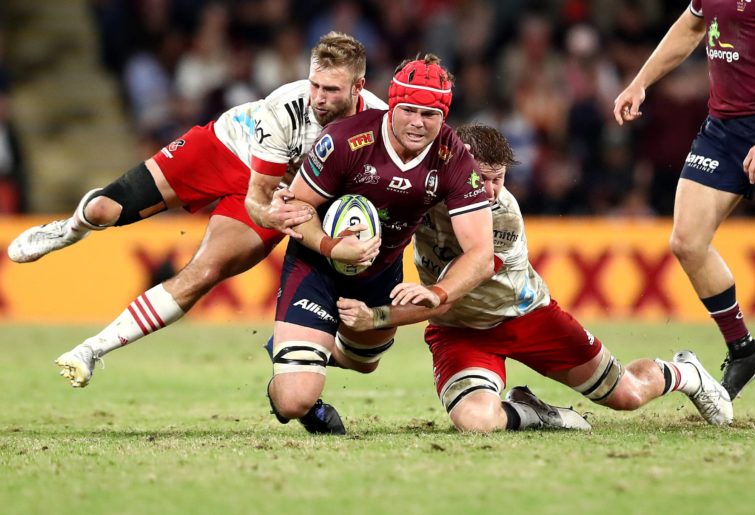
(Photo by Jono Searle/Getty Images)
All the provincial Kiwi teams are head and shoulders above the Aussie teams in almost every aspect of the game, especially the fact they can grind through for the full 80. Aussie teams are 40-minute teams and if they lasted the first 40, they will melt like butter towards the end of the second 40 minutes. It happened to the Reds against the Chiefs.
To be honest, there is nothing wrong with the quality of the Aussie players, they are as good, and many of them are even better than some of the Kiwi players with All Blacks experience. The fault lies with how they were coached and strategy and tactics to be used to confront each of these Kiwi teams.
As I said before, Australian rugby is one-dimensional, unimaginative and full of predictable tactics being used in every game when they have the ball in hand. Rarely will you see a sense of awareness for creativity and for individual brilliance.
Kiwi rugby is best exemplified by Damian McKenzie, Richie Mo’unga and Aaron Smith. They exhibit creativity and are always engaged in scenario-building with the ball in hand and are not hamstrung by having to play to script. They and other Kiwi players, especially the forwards, will force you to tackle them to the ground before they actually decide to fall with the ball. And you can see they would try to snake around and away from their opponents.
Whereas Aussie forwards, when they have the ball in hand, will invariably put their heads down and charge like a drunken bull into the opponent’s body. And our backs will purposefully run straight into the face of the opponent without making a real effort to find ways to avoid getting tackled.
As they say, insanity is defined as doing the same thing every weekend and expecting a different result on the rugby field.
The Bledisloe Cup? At this rate, the opening bet will be guessing how many tries the All Blacks will pile up on the Wallabies unless coach Dave Rennie can make the Aussie players think outside the box for the full 80 minutes when they have the ball in hand.
Original source: https://www.theroar.com.au/2021/05/30/the-trans-tasman-showed-a-glaring-weakness-in-australian-rugby/
https://therugbystore.com.au/the-trans-tasman-showed-a-glaring-weakness-in-australian-rugby/
The Wrap: Reds take their learnings to break Australia’s Super Rugby duck
Grammarians universally frown upon the modern usage of the word ‘learnings’ as a dubious pluralisation of a singular noun. Meanwhile, rugby players and people aged under 30 wonder what on earth a grammarian is and continue to use ‘learnings’ with gay abandon.
What is more interesting than arguing semantics over the evolution of language is observing the sheer number of times a losing skipper will trot out the obligatory line about taking learnings from this week’s failures only for his side to fail to remedy matters the following week.
The word is rendered valueless not because of grammar but because it rolls off the tongue like a hundred other rugby cliches without any accountability attached.
What is more interesting again is when a side like the Reds, thumped one week in front of its home fans, retreats not only to lick its wounds but to actually apply the lessons from defeat, addressing both their defensive frailties and adopting some of the attacking methods that worked so well against themselves to apply against their next opponent.
The Chiefs opened strongly in Townsville, bending the Reds in close and out wide, but unlike the week before against the Crusaders, there was far better connectedness, cohesion and execution in the defensive line. The Chiefs’ best shots were repelled and the seeds of Australia’s first franchise victory in Super Rugby Trans-Tasman were sown.
Over the next 30 minutes those seedlings sprouted to the extent that the halftime lead was 33-3; the contest, seemingly, was as good as over.
No matter that a chunk of that time was played against 14 men and then more again against 13; the Reds still had to get things right. With respect to covering for missing players, not all cards are born equal, and the Chiefs losing both Chase Tiatia and Damian McKenzie left them bereft of manpower and speed on the edges, which James O’Connor and Tate McDermott recognised and ruthlessly exploited.
For the first time in this competition, an Australian side shifted the ball around with pace and precision, and players ran hard and straight into space. It was all so reminiscent of what the Crusaders had done to them last week but, hey, that’s what happens when you don’t just talk about taking learnings but actually walk the talk.
The Reds’ breakdown work was far more effective. McDermott looked a different player with front-foot ball – and what about the manful 80-minute effort of Lukhan Salakaia-Loto in attack and defence? It was a timely shift with Test selection just around the corner.
The Chiefs were powerless to plug the gaps, and by the time parity in numbers was restored, like a chip at a trendy, modern Australian bistro, they’d already been thrice cooked.
As it turned out, while they might not have wanted or expected one, the Townsville crowd got a bonus grandstand finish, with the Chiefs, incredibly, working themselves back into the match to such an extent that at 40-36 they had a shot at victory in the final minute.
It could have been even more nail-biting; take another look at replacement halfback Kalani Thomas feeding the final scrum, facing towards his own goal-line and sending the ball straight towards his No. 8 and ask yourself why referee Nic Berry didn’t give the Chiefs one more chance from a free kick.
All hell would have broken loose, and Townsville of course is rugby league country, where farcical scrums are a dime a dozen, but this one made an utter mockery of rugby’s laws. Berry would not tolerate a lineout throw being made straight to the halfback or a 45 degree forward pass. Why should things be any different at a scrum?
One thing Berry did get spot-on was the first-half sin-bin of Tiatia and the awarding of a penalty try to the Reds for a deliberate slap at the ball. For reasons that escape me this is a widely unpopular law, with offenders and fans alike running the ‘but I was going for the intercept’ or ‘but what else was I supposed to do?’ defence.
Of course Tiatia and the Chiefs had other options. They could have scrambled more players across in defence, allowing Tiatia to mark up properly on his winger, or Tiatia could have used two hands in a genuine attempt to catch the ball, or Tiatia could simply have kept his hands to himself, and instead of conceding seven points and a yellow card, conceded five points in the corner and stayed on the field.
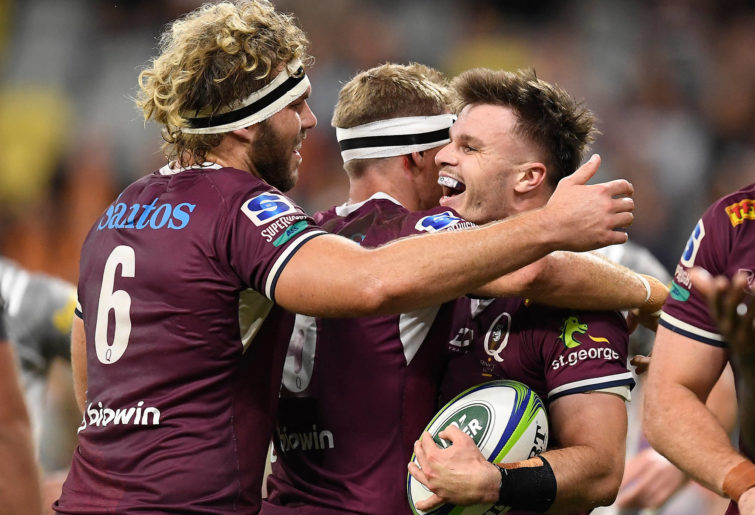
(Photo by Ian Hitchcock/Getty Images)
Less convincing was the dismissal of McKenzie for what Berry, looking at a one-dimensional image on a big screen in a stadium, himself said, “It looks like he makes direct contact with the head”.
McKenzie entered the contact area at too much of an angle to make a front-on tackle, was always too upright and rose even higher at the point of contact. It was a poor tackle, and by putting himself at the mercy of the officials, with precedents well established, he can have no complaint in that made his own bed.
But there remains a wider concern that the push to lower tackle heights and minimise concussion incidence requires a more nuanced approach. That the threshold for a red card has been sharply lowered in recent times is one thing; note that McDermott was not only not concussed, he wasn’t even asked to submit for an HIA.
Asking referees to play judge, jury and executioner using questionable vision when something “looks like” a red card offence is another. It used to be easy to determine the intentional, violent or reckless acts that were worthy of a red card. Toni Pulu, Pone Fa’amausili and now McKenzie do not fall into that category, and the process as it sits feels uncomfortably fragile and inequitable.
Minimising concussion instances is a critical objective. But that should not prevent a discussion about whether a ‘one size fits all’ approach serves our referees or the game as well as it should. For as long as the current framework continues expect more difficult and contentious moments ahead.
Sports opinion delivered daily
While the Reds got the clean sweep off the table, it was business as usual elsewhere, with the Hurricanes burning the Force in Napier 43-6 through the speed of their transition into attack, a common theme throughout this competition.
Two examples illustrated the difference. Firstly, the kindest way to describe Force hooker Andrew Ready overshooting a lineout throw and then plodding after his opposite, Asafo Aumua, as he sped 60 metres to score was that here were two players who didn’t belong on the same pitch.
And while Tyrel Lomax cleanly stripping the ball from a Force runner was impressive enough, it was the speed at which the Hurricanes hurt them on the transition, with Du’Plessis Kirifi running away to score, that felt all too familiar.
Fans who braved the stiff breeze in Wollongong were rewarded with a highly entertaining match, even if the Crusaders were never troubled on their way to a 54-28 win.
It was no surprise to find the Crusaders down on intensity from their Brisbane showpiece, yet the instinct to support the ball carrier, inside and out, was still ever-present, resulting in some delightful flowing tries.
As has been their recent custom, the Waratahs managed a few nice tries of their own, Izaia Perese was again a real handful, and the message to fans must surely be that there is a good young side lurking not too far below the surface that will be worth more than a second glance this time next season.
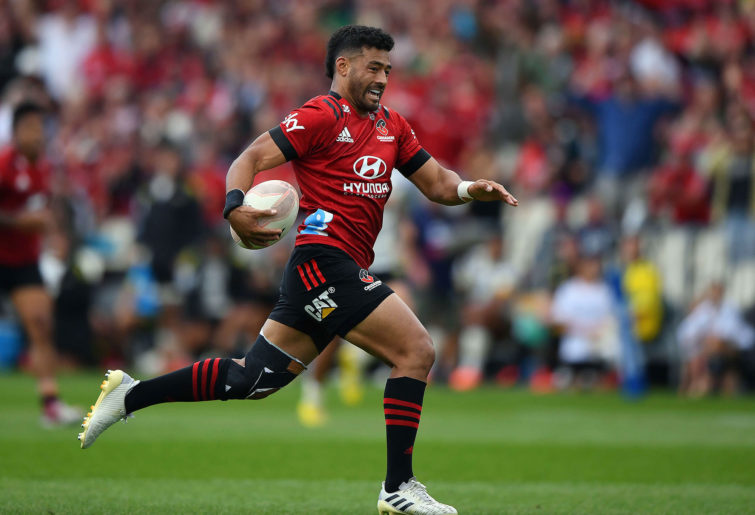
Richie Mo’unga (Photo by Kai Schwoerer/Getty Images)
In Auckland the Brumbies brought more intensity and a better scrum but still proved no match for the Blues, who controlled the match in the second half on their way to an impressive 38-10 bonus-point win.
The Blues of recent years might have dropped their bundle or froze at the prospect of grinding out 40 minutes to overcome spirited opposition, but buoyed by a thrilling try to halfback Finlay Christie right on halftime, this 2021 version went right on with the job in a very professional manner.
The returning Patrick Tuipulotu got more minutes than what he would have been expecting, but fans will have been delighted to see him roll his sleeves up to help keep the Blues in sight of one of the two finals spots.
In a surprise twist the Brumbies scrum found favour with referee Damon Murphy, but they were spanked at the breakdown, conceding turnovers at a rate of two to one. After a tough three weeks on the road, they’ll be keen to lift at home, but Rob Valetini can’t be expected to carry all of the load on his own.
The Leichhardt Oval hill isn’t exactly Queenstown’s Remarkables, but full credit to everyone involved for getting the final match of the round played yesterday under trying circumstances. Let’s hope that Queenstown, a tourist destination suffering badly under COVID, is rewarded with a match at the first available opportunity. It’s the least that they deserve.
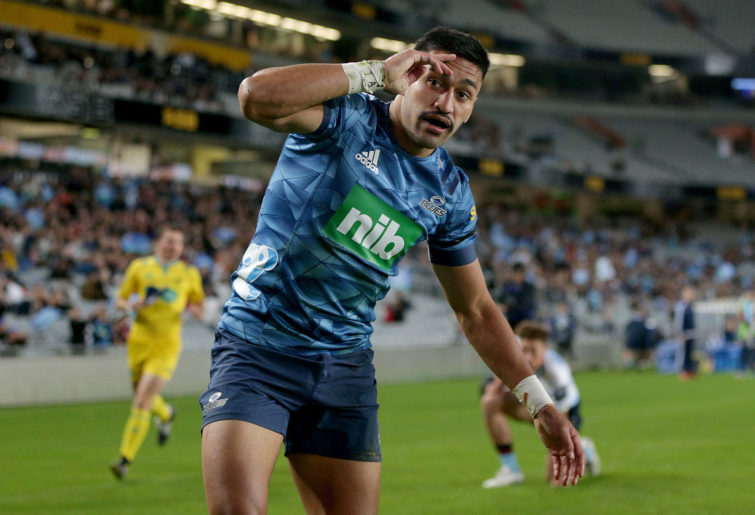
Rieko Ioane (Photo by Dave Rowland/Getty Images)
The Highlanders’ class edge saw them come out on top 42-27, although both sides came away feeling that the result was a missed opportunity. Missing out on a try-scoring bonus point, the Highlanders are now likely out of finals contention, although if Aaron Smith was frustrated at being denied that point by a couple of inches, he can take solace that his pick-up and transfer in the lead-up to Sio Tomkinson’s first-half try was of another world.
Meanwhile, the Rebels took the lead 15-14 soon after halftime and were well placed enough, if good enough. But instead of clinically turning the screws, two pieces of schoolboy-level ill discipline, firstly from Lachie Anderson and then from Jordan Uelese – seemingly begging referee Paul Williams to give him a yellow card – cruelled their chances.
With Michael Wells and Rob Leota their two best players, the Rebels rolled the dice and, instead of the usual loose forward sacrifice, elected to take Anderson, a winger, from the field. Flyhalf Mitch Hunt recognised where the space was and, ten minutes and 21 points later, the match was effectively decided.
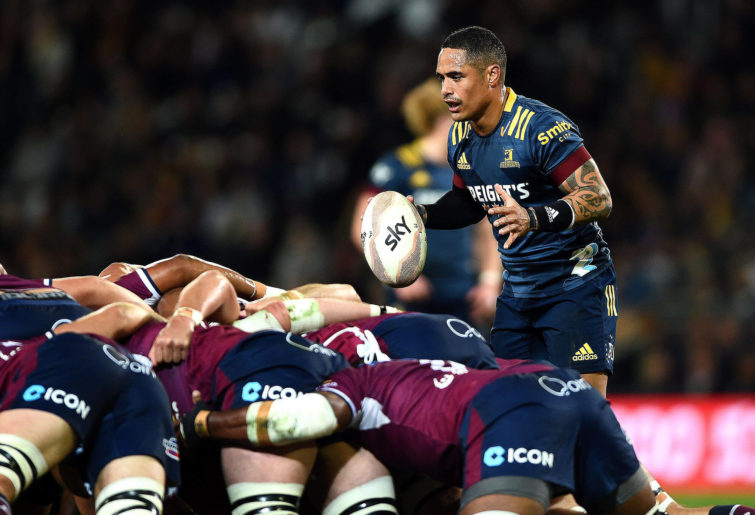
Aaron Smith (Photo by Joe Allison/Getty Images)
The format for next year’s Super Rugby competition is far from decided, and there is the feel of another trans-Tasman stoush brewing over the competition format.
Understandably, Rugby Australia wants to build on the momentum gained by this year’s Super Rugby AU competition and would be happy with that as the major component followed by some form of crossover competition with New Zealand.
NZ Rugby, backed by their franchise coaches and players, prefer a smaller domestic component, with the main course a full home-and-away combined competition.
Adding complexity is the potential addition of Moana Pasifika and the Fijian Drua, a ticking time bomb planted by Brent Impey on his way out of the chairman’s seat, which has the widespread support of everyone except the people whose job it is to actually find a way to make it work.
Do not be surprised if – behind firmly closed doors – this emerges as a key bargaining chip during negotiations.
Japan is also a factor – again, everyone wants to see them involved in some capacity, but like a game of rugby musical chairs, it feels like there are too many people circling the room and not enough chairs for when the music stops.
Rugby Australia will be buoyed by standing firm against New Zealand last year and emerging stronger as a result. New Zealand Rugby will believe that their ongoing dominance on the field entitles them to ‘senior partner’ status.
Perhaps the learnings to take from last year are that, once the posturing and preening are over, both sides know that they have no choice but to work together constructively to play to their combined – not individual – strengths.
Original source: https://www.theroar.com.au/2021/05/31/the-wrap-reds-take-their-learnings-to-break-australias-super-rugby-duck/
Premiership: Harlequins 44-33 Bath - hosts win 10-try thriller to book play-off spot
Harlequins secure a Premiership play-off place with a bonus-point victory against Bath at The Stoop.
Original source: http://www.bbc.co.uk/sport/rugby-union/57244199
Wednesday, 2 June 2021
Premiership: Sale Sharks 22-12 Bristol Bears - Sale book play-off place with win
Sale come from behind to beat leaders Bristol and book their place in the Premiership play-offs
Original source: http://www.bbc.co.uk/sport/rugby-union/57244193
The Trans-Tasman conundrum, solved
There’s been a lot of talk lately about the best way forward for Australian rugby teams in terms of a Trans-Tasman competition, given that early results in this year’s tournament have been eerily akin to watching a silverback gorilla repeatedly slamming a chihuahua’s head in a car door.
The question of how to maintain strong Trans-Tasman competition while avoiding chronic depression among Australian players is a vexed one, but I think I have come up with an elegant solution. Here then is my model for a new Trans-Tasman Super Rugby premiership, hopefully to begin in 2022, if I get approval from RA and Alan Jones.
The structure is fairly simple: the competition will be made up of the five currently existing Australian teams, and the five current New Zealand teams. But there will be some tweaks to the rules regarding team rosters:
- Australian clubs will have a maximum of 45 players on their books at any one time, while New Zealand teams will be allowed up to 17.
- Australian clubs will be allowed up to five New Zealand players on their roster. New Zealand clubs can likewise have five Australian players in their teams, but only in the event of a serious breach of the rules that would merit such a serious punishment.
The on-field rules will be adjusted slightly as well: whereas in the past yellow cards were shown to players who committed acts of dangerous play, in the new competition each NZ team will have to nominate three players to receive automatic yellow cards before the game. This will mean they start the game with only 12 players, which will assist in the cause of equalisation.
(Photo by Dave Rowland/Getty Images)
By the same token, any Australian player shown a yellow card will not be sent from the field, but will be required to think very hard about what he’s done. If an Australian player receives a red card, he will be allowed to stay on the field, but will have to wear a special red shirt so everyone knows he’s been bad.
If a New Zealand player receives a red card, he will be required to sign with an Australian team.
The draw will remain basically as it is now, except that Australian teams will play each other four times every year, and play each New Zealand team only once, if they feel up to it. A win will be worth four points, but a win by an Australian team over a New Zealand team will be worth 12. A win by a New Zealand team over an Australian one will be, as it is now, worthless.
All games will be played at Concord Oval.
So as not to exhaust Australian players unnecessarily, all games will be 30 minutes long, except for games between New Zealand teams, which will be 180 minutes long and played on cement.
(Photo by Jono Searle/Getty Images)
The finals format will be streamlined: the top four Australian teams will play each other, and whichever one comes out on top will play the fifth-placed New Zealand team for the right to play in the grand final, which the top-ranked New Zealand team must decipher a series of cryptic clues to discover the time and location of. If the fifth-ranked New Zealand team defeats the top-ranked Australian team, the grand final will be cancelled due to coronavirus.
Obviously not everyone will be on board with this format, so I have devised an alternative system, whereby the New Zealand teams play among themselves to determine the champion in that country, while the Australian teams go out for pizza and ice cream and try to feel good about themselves.
Either way, you know?
Original source: https://www.theroar.com.au/2021/05/29/the-trans-tasman-conundrum-solved/
https://therugbystore.com.au/the-trans-tasman-conundrum-solved/
Subscribe to:
Posts (Atom)